In today’s manufacturing environment, efficiency is no longer just a competitive advantage. It is a necessity. Material costs continue to rise, lead times are getting tighter, and customers expect accurate parts without unnecessary waste or delays.
For many fabrication and cutting operations, the biggest gains do not always come from major process changes. More often, they come from small, intelligent improvements that work together across every sheet, every nest, and every job.
That is where HD SuperNEST adds value.
HD SuperNEST continuously refines individual part placements to create smarter, more efficient nesting layouts. Instead of settling for the first acceptable result, it keeps searching for better configurations that can improve material utilisation and reduce scrap. This gives nesters and programmers a more advanced way to improve efficiency without adding unnecessary manual work to the nesting process.
Applications and Use Cases
High-Value Materials and Expensive Substrates
When working with costly materials such as composite sheets or specialty alloys, every millimetre matters. Even small inefficiencies in a nest can build up into significant material waste, especially when expensive substrates are used across multiple jobs.
HD SuperNEST takes a more refined approach by continuously improving part placement to extract more value from each sheet. This makes it especially useful in environments where scrap must be kept to a minimum and every sheet needs to be used as effectively as possible.
High-Mix, Moderate-Volume Shops
Shops that process a wide variety of part geometries need to balance flexibility with efficiency. A nesting strategy that works well for one job may not produce the same results when new parts, different materials, or changing priorities are introduced.
HD SuperNEST performs well in these environments because it can re-optimise layouts as job requirements change. This helps the system adapt to different part combinations while still aiming for strong material utilisation.
Steel Service Centres and Plate Cutting Operations
Steel service centres and plate cutting operations often process multiple grades and thicknesses in a single day. In these environments, even small improvements in yield can add up across a large number of sheets.
HD SuperNEST helps ensure that each sheet is used more effectively. Over time, these incremental improvements can support more consistent savings, especially in operations where material consumption has a direct impact on profitability.
Situations Requiring Stability and Consistency
Some cutting and fabrication processes require more than just a tight nest. They also require stable, predictable layouts. This is especially important in processes such as punching, forming, or stacked cutting, where consistent web widths and reliable part positioning can affect downstream performance.
HD SuperNEST supports these requirements by producing tighter and more uniform nests. This helps improve both part quality and process reliability, while also supporting a more controlled production workflow.
Key Benefits of HD SuperNEST
Improved Material Yield and Waste Reduction
HD SuperNEST does not stop at the first acceptable layout. It continues searching for improvements and often identifies tighter configurations that reduce scrap.
In the example provided, standard nesting produced 23.47% scrap, while the HD SuperNEST engine reduced scrap to 16.82%. This represents a total saving of 6.65%. In high-value material environments or high-throughput operations, that difference can become meaningful over time.
Reduced Programming Time and Better Automation
Manual nesting adjustments can take time, especially when programmers need to review and refine layouts for better material utilisation. These manual changes can also lead to inconsistent results, depending on the complexity of the job and the experience of the programmer.
HD SuperNEST automates the iterative optimisation process, reducing the need for manual intervention while still searching for improved layouts. This helps programmers spend less time adjusting nests manually and more time focusing on production priorities.
Optimised Tool and Motion Behaviour
Nesting performance is not only about how parts fit on a sheet. It also affects how the machine moves, cuts, and processes each job.
HD SuperNEST works with advanced cutting strategies such as common-line cutting, chain cutting, bridge cutting, tabbing, and repositioning. These strategies can help improve machine performance and support more efficient cutting paths, which may also contribute to reduced cycle times depending on the job setup.
Flexibility and Customisation
Different operations have different priorities. Some teams may want the system to search more aggressively for material savings, while others may need to balance optimisation with speed, part priority, or production constraints.
HD SuperNEST allows users to adjust optimisation settings to suit their workflow. Parameters such as optimisation attempts, lookahead factors, and part priorities can be configured to control how the system searches for improvements.
The system also supports remnant nesting, continuous nesting across work orders, best sheet selection, and mixed material groupings. This gives fabrication teams more control over how materials are selected, used, and carried forward into future jobs.
Improved Remnant Shaping
Remnants are only valuable when they can be reused effectively. Irregular remnants may be difficult to store, manage, or apply to future jobs, which can reduce their practical value.
HD SuperNEST aims to produce remnants that are more regular in shape, with a preference for rectangular forms. This makes leftover material easier to reuse and helps reduce overall waste across future production runs.
Standard Nesting vs HD SuperNEST
The impact of HD SuperNEST becomes clear when comparing standard nesting results against the HD SuperNEST engine.
Standard Nesting Engine
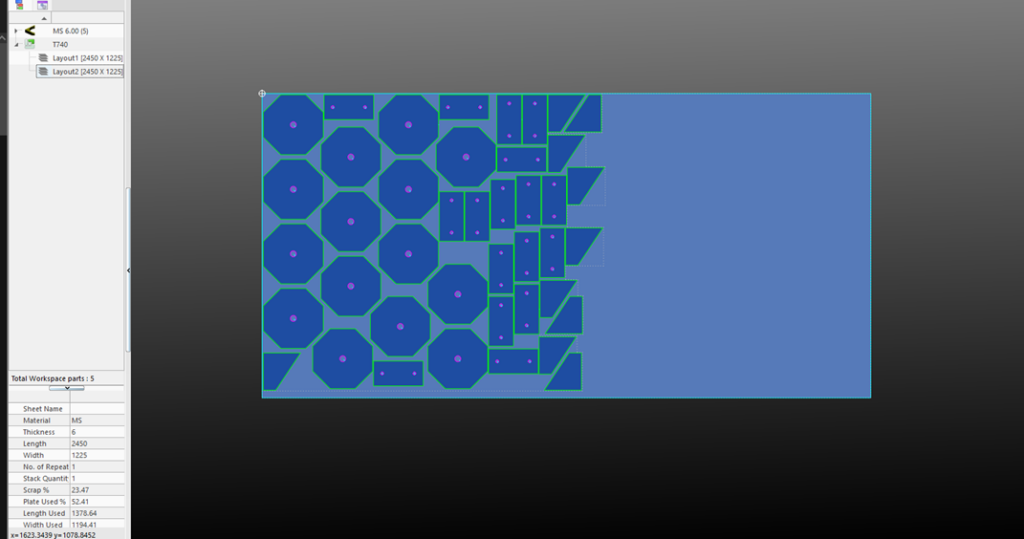
Scrap: 23.47%
HD SuperNEST Engine
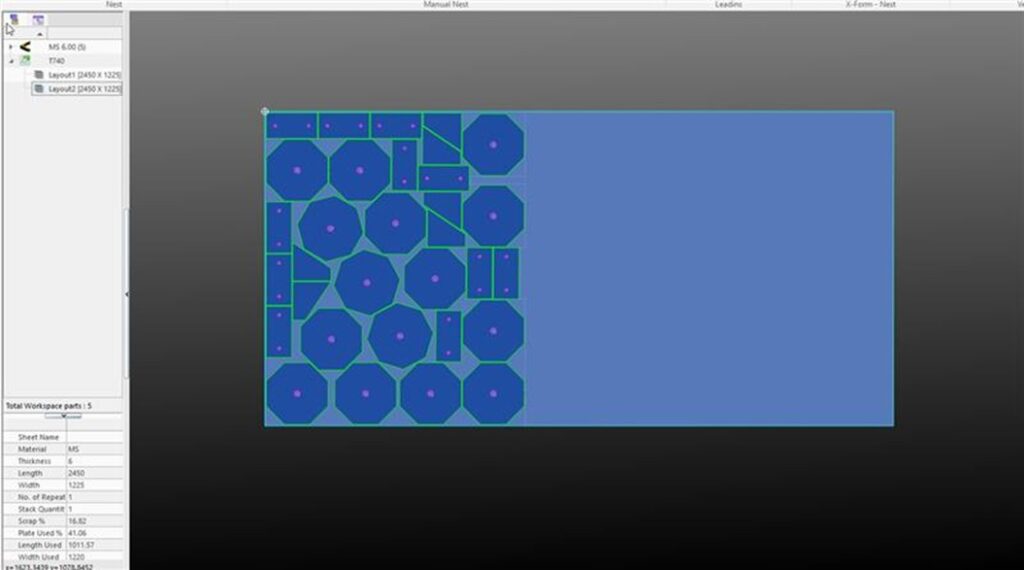
Scrap: 16.82%
Total savings: 6.65%
This example shows how smarter nesting can create measurable improvements without requiring a complete change to the production process. By continuously refining part placement, HD SuperNEST helps manufacturers reduce scrap, improve material usage, and get more value from each sheet.
The Bottom Line
HD SuperNEST is designed for manufacturers that want to improve material efficiency without relying on time-consuming manual adjustments. By continuously refining nest layouts, supporting advanced cutting strategies, and improving remnant usability, it helps turn small placement improvements into meaningful material savings.
For operations working with expensive materials, high-mix production, steel processing, or stability-critical cutting applications, these improvements can make a measurable difference over time.
Next step: Speak to MECAD Manufacturing to find out how HD SuperNEST can support smarter nesting, better material utilisation, and more efficient cutting workflows in your operation.