Production cost consist of the following:
- Global Costs
- Machine Costs
- Process Costs
- Other Costs
Global Cost
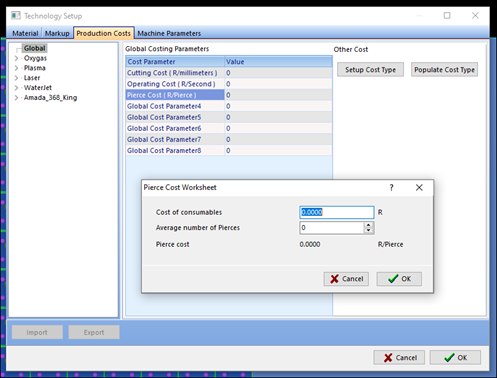
Global costs are applied across all the machines and their processes. This includes global cutting cost, – operating cost, – piercing cost etc.
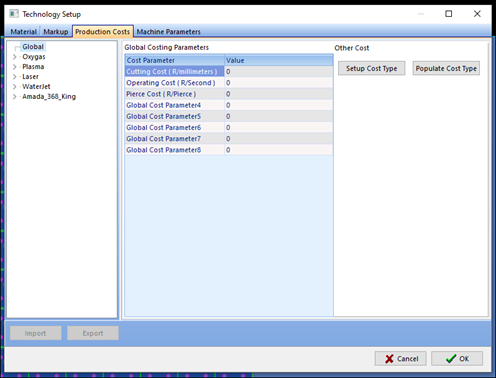
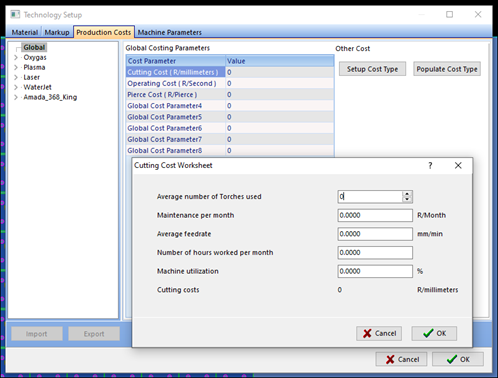
Each global cost comes with a handy calculator showing you which costs need to be taking into consideration when calculating the global cutting cost, operating cost, piercing cost etc.
Machine Cost
You can configure Machine Costs to calculate costs associated with running a particular machine. This includes the financing, operating, and labour costs.
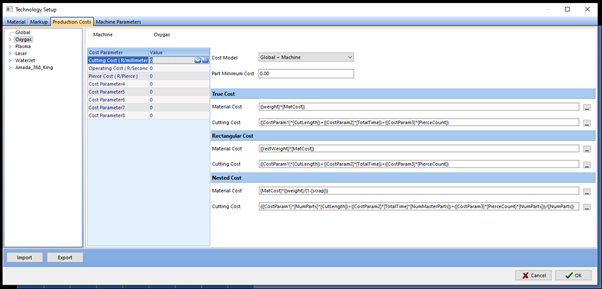
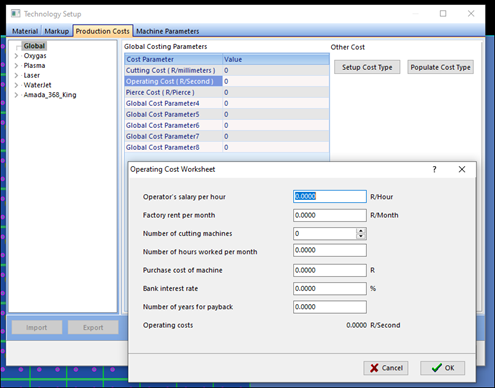
The same as in global cost each machine cost come with a handy calculator showing which costs need to be taking into consideration when calculating that particular machine cost.
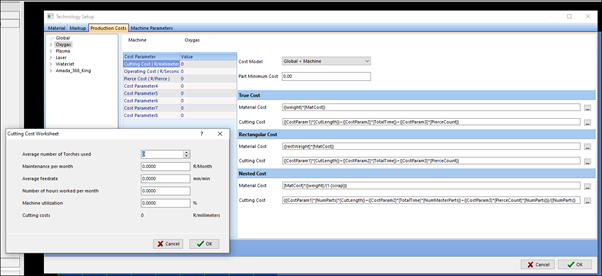
Cutting Cost factors are usually the average number of cutting heads used, gas, nozzle, mirror, lenses, the use and general maintenance of the machine, and the machine’s typical feedrate, number of hours worked, and utilization rate.
Cutting cost per in/mm = [Average number of torches used * Maintenance cost per month * 100] / [Average feedrate * Number of hours worked per month * Machine utilization percentage * 60 seconds]

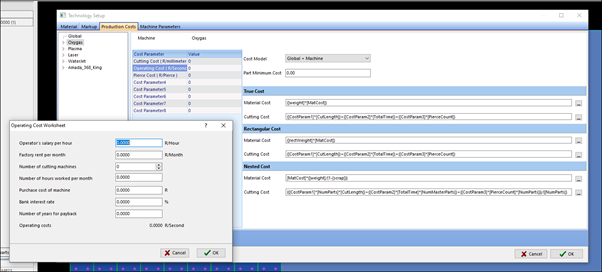
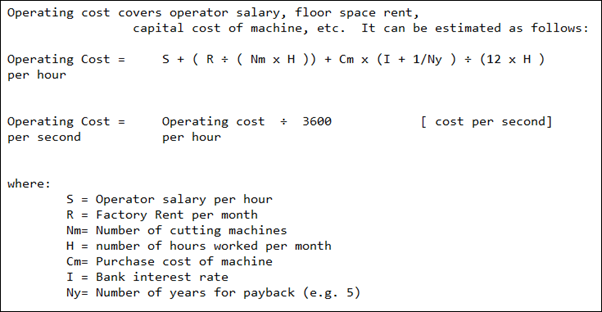
Operating Cost factors are usually operator’s salary or wages, the number of hours worked, and the financing costs of the machine.
Operating cost per hour = Operator’s salary per hour + [Factory rent per month / (Number of cutting machines * Number of hours worked per month)] + Purchase cost of machine * [(Bank interest rate / 100) / (1 / Number of years for payback)] / (12 * Number of hours worked per month)
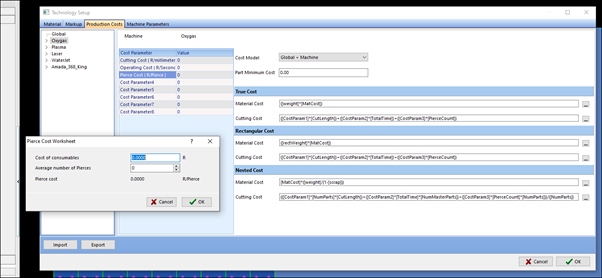
Piercing Cost is the cost per pierce.
Cost per pierce = Cost of consumables / Average number of pierces

Process Cost
You can define Process Costs for every process a machine supports, such as Oxyfuel, Plasma, and Drill. Process Costs have the same parameters as global and machine costs, but they are defined by process, material, and thickness. For example, materials that vary in thickness may cost a different amount when running the same process.
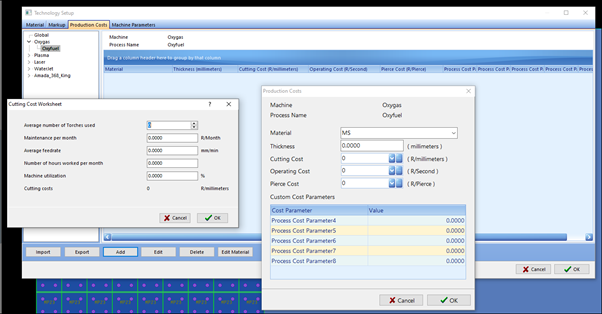
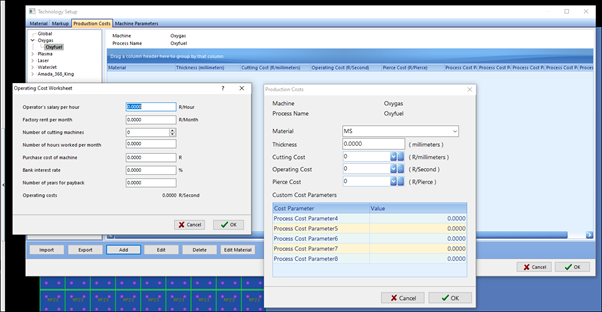
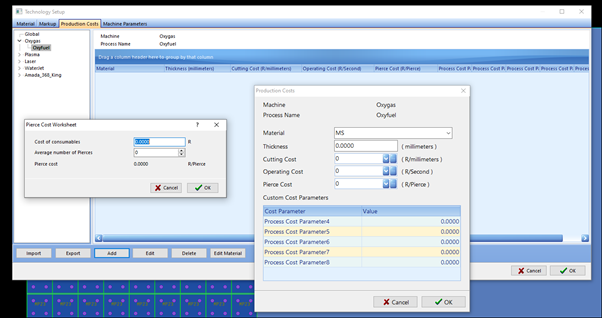
Material – Select a material type from the list.
Thickness – The thickness of the material for the machine and process type.
Cutting Cost – The cutting cost per unit of cutting length.
Running Cost – The running cost of the process per unit of time (second).
Pierce Cost – The cost per pierce.
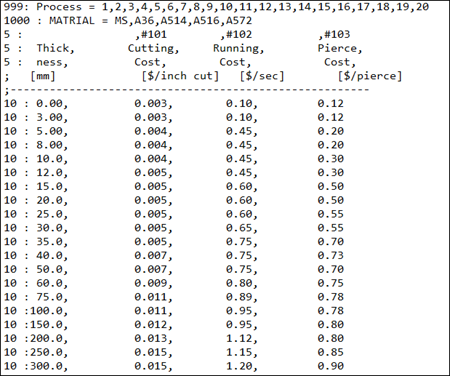
Other Cost
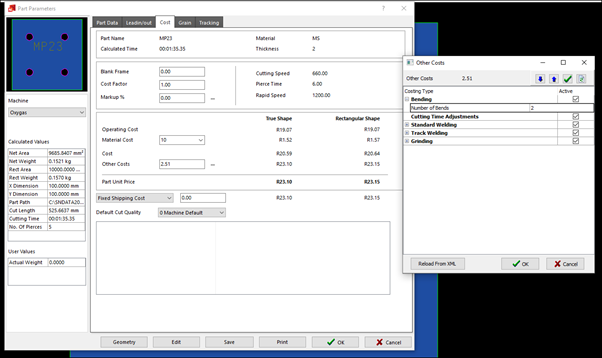
You can use Other Costs to define any additional costing associated with the part, such as additional handling, bending, grinding, or welding costs.
Bending Cost
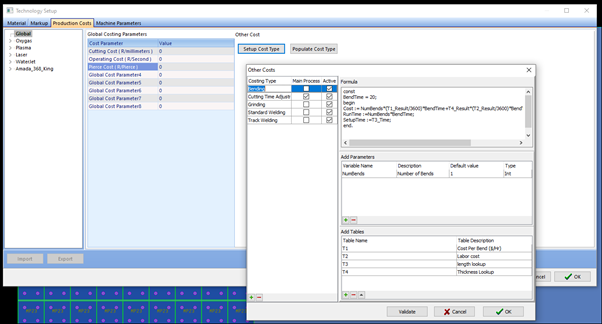
const
BendTime = 20;
begin
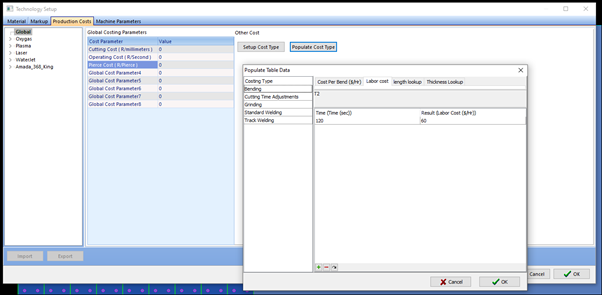
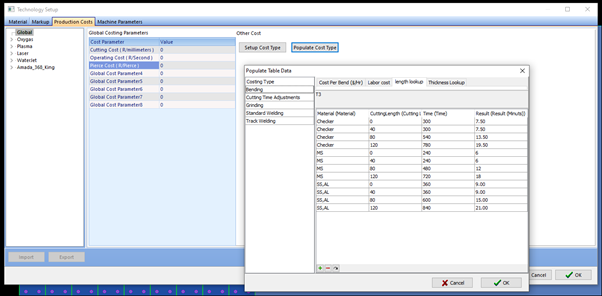
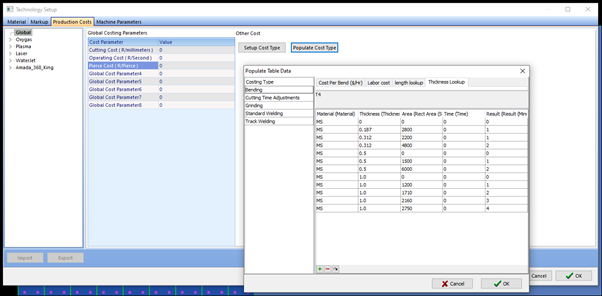
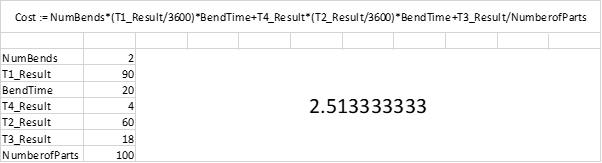
Cost := NumBends(T1_Result/3600)BendTime+T4_Result(T2_Result/3600)BendTime+T3_Result/NumberofParts;
RunTime :=NumBends*BendTime;
SetupTime :=T3_Time;
end.
Cost Per Bend (T1_Result)
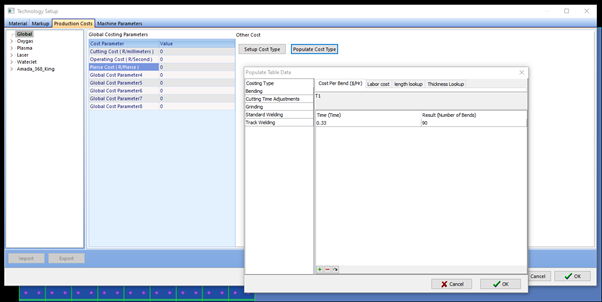
Labor Cost (T2_Result)
Length Lookup (T3_Result)
Thickness Lookup (T4_Result)
If this is something you would like to add to your costing process, please call in and have your application engineer assist. One of the perks of being on active maintenance.